Infrastructure of Significance: Arctic Logistics and the Future of Canadian Sovereignty
Why middle powers must rethink mobility, persistence, and sovereignty in the Arctic age
By Commander Norm Normand
For much of the post-Cold War era, Canada enjoyed the strategic luxury of geographic insulation. Protected by three oceans, allied with the United States, and buffered by the relative stability of the international order, Canada was rarely forced to think seriously about the operational realities of Arctic sovereignty beyond periodic political declarations and symbolic gestures. Today, however, that strategic environment is changing rapidly.
Canadian Sovereignty Under Threat:
Renewed great-power competition, increasing Arctic accessibility caused by climate change, expanding Chinese and Russian activity in the circumpolar region, and growing pressure from the United States regarding continental defence have collectively forced Canada to confront a difficult reality: sovereignty in the Arctic cannot be maintained through declarations alone. It requires persistent presence, infrastructure, mobility, and sustainment.
Recent tensions surrounding the Permanent Joint Board on Defense (PJBD), the framework originally established by the 1940 Ogdensburg Agreement and associated criticism from American officials regarding Canada’s level of Arctic defence investment illustrate the growing impatience of allies who increasingly view the Arctic as a contested strategic environment rather than a distant frontier. On 18 May 2026, Elbridge Colby, undersecretary of defense for policy at the U.S. Department of Defense, posted to X on the following statement:
“unfortunately, Canada has failed to demonstrate credible progress toward fulfilling its defense commitments […] the Department of Defense is temporarily suspending activities in order to reassess what benefits the Permanent Joint Board on Defense (PJBD) brings to North American collective defense.”
At the same time, Canada faces enormous fiscal and geographic constraints. As a middle power with a relatively small population spread across one of the largest national territories on Earth, Canada cannot realistically compete with major powers through symmetrical spending alone.
Prime Minister Mark Carney’s speech at Davos offer an important framework for understanding Canada’s strategic dilemma. In that speech, he said the following:
“More recently, great powers began using economic integration as weapons. Tariffs as leverage. Financial infrastructure as coercion. Supply chains as vulnerabilities to be exploited. You cannot “live within the lie” of mutual benefit through integration when integration becomes the source of your subordination.”
Middle powers cannot afford to pursue great-power competition on purely quantitative terms. Instead, they must pursue strategic efficiency: investments that maximize resilience, presence, and operational flexibility while remaining fiscally sustainable.
In the Arctic, this means rethinking infrastructure itself.
Canada’s Arctic challenge is not simply one of military underinvestment. It is fundamentally a logistics and mobility problem.
The country’s northern geography presents staggering operational difficulties. Much of the Canadian Arctic remains characterized by sparse transportation infrastructure, limited road access, seasonal sealift dependency, extreme weather conditions, and vast distances between population centres. Conventional transportation systems are expensive to build, difficult to maintain, and often highly vulnerable to environmental conditions.
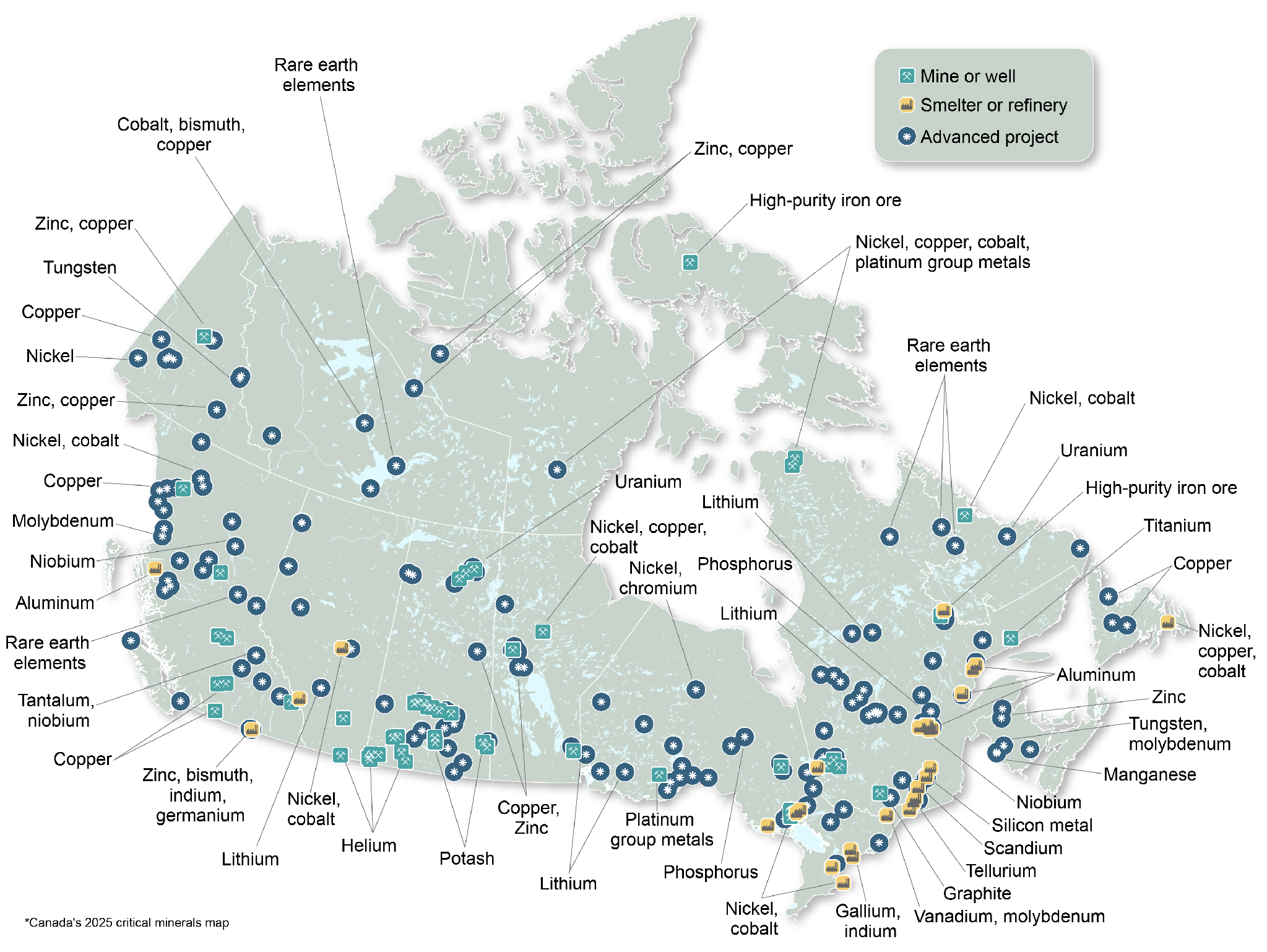
At the same time, the strategic importance of the region is growing rapidly. Critical mineral deposits across northern Canada are attracting renewed economic interest (see figure 1 below).
Figure 1 – Critical Mineral Opportunities Spanning All Regions of Canada
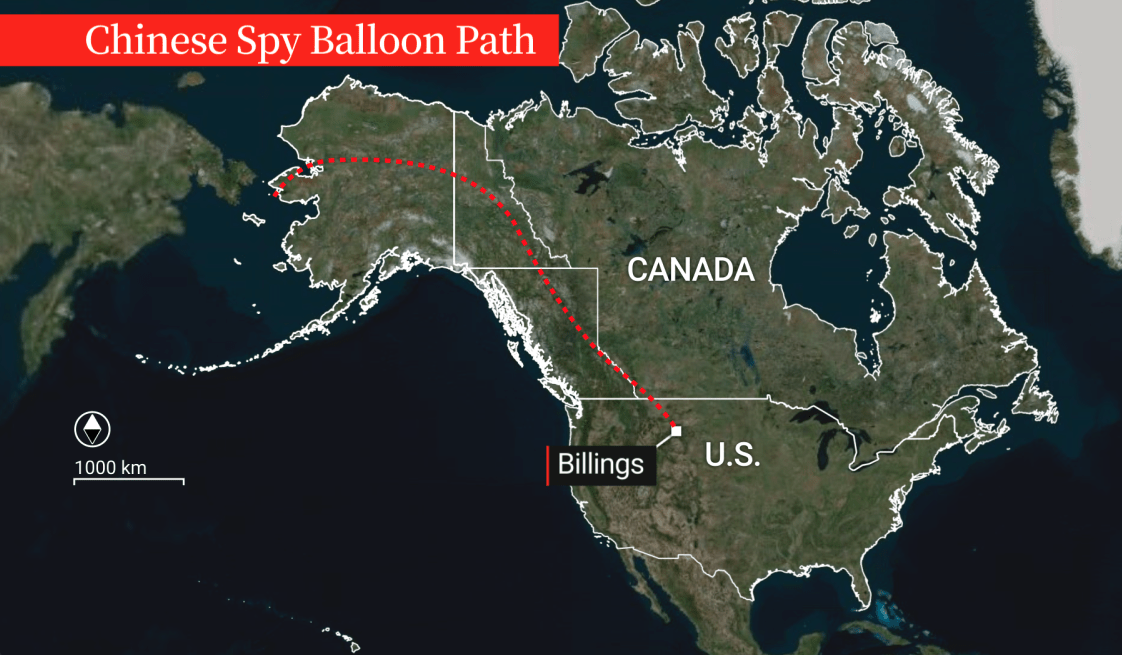
Arctic shipping activity is gradually increasing. Foreign military and scientific activity in the circumpolar region continues to expand. The Arctic is becoming visible again in global strategic calculations. This interest by foreign actors was illustrated vividly during the Chinese surveillance balloon incident in early 2023 (See Figure 2 below).
Figure 2 – Jan 2023 Chinese Spy Balloon Path
The reason cited for the late detection of this balloon (that had travelled thousands of kilometres over both American and Canadian territory) was because, as MGen Paul Prevost (Director of Staff, Strategic Joint Staff at the time) stated: “there was no infrastructure of significance along the balloon’s flight path.” The phrase: “no infrastructure of significance” deserves serious reflection because it identifies the true nature of Canada’s sovereignty challenge.
Sovereignty is not merely a legal concept tied to maps and territorial claims. In operational terms, sovereignty requires the ability to observe, access, sustain, regulate, and respond across a territory. It requires persistence. States exercise their authority through infrastructure and mobility.
In the Arctic, logistics capability becomes governance capability.
The conventional response to Arctic infrastructure gaps is usually framed in terms of building more roads, more runways, more ports, more icebreakers, and more conventional airlift capability. All of these investments are valuable. However, they are also extraordinarily expensive, slow to deploy, and difficult to scale across Canada’s enormous Arctic geography.
As a middle power, Canada must therefore think carefully about how to maximize sovereign presence per dollar spent. This is where alternative mobility systems become strategically relevant.
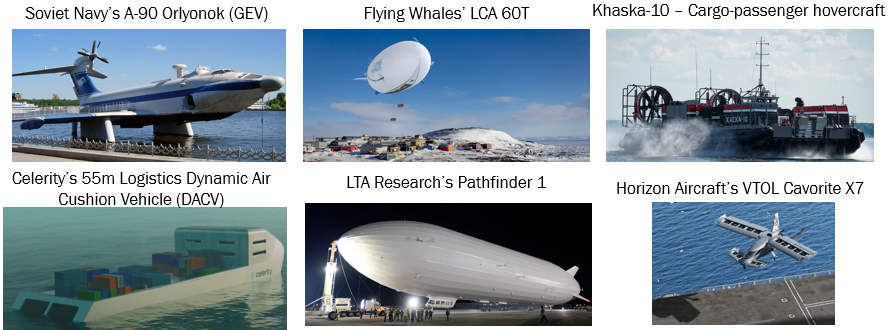
Low Infrastructure Demand Vehicles (LIDVs) such as cargo airships, hovercraft and ground effects vehicles are often dismissed as futuristic curiosities or relics of a bygone era. Yet advances in materials science, automation, avionics, and weather forecasting have renewed international interest in lighter-than-air transportation systems, particularly for remote logistics applications. Figure 3 below shows some examples of LIDVs some of which are currently in use and others which are currently in development.
Figure 3 – Examples of Low Infrastructure Demand Vehicles (LIDVs)
The question is not whether LIDVs should replace conventional infrastructure. Rather, the question is whether they can function as infrastructure multipliers capable of increasing Canada’s operational reach and strategic flexibility.
Unlike roads, railways, or runways, LIDVs can provide persistent mobility without requiring massive (and expensive) fixed infrastructure investments across remote terrain. LIDVs ability to operate across distributed northern networks makes them uniquely interesting from both logistical and sovereignty perspectives.
Most importantly, LIDVs have the potential to create what might be described as “infrastructure of significance” without replicating the full capital costs associated with conventional northern transportation corridors.
This has implications extending far beyond military logistics.
Resource Security:
A key element of National Security is Resource Security. The ability of Canada to responsibly develop, sustain, and export its northern resource base is inseparable from long-term national resilience and strategic independence. Critical minerals, energy resources, and northern transportation corridors increasingly form part of the geopolitical competition now emerging across the Arctic.
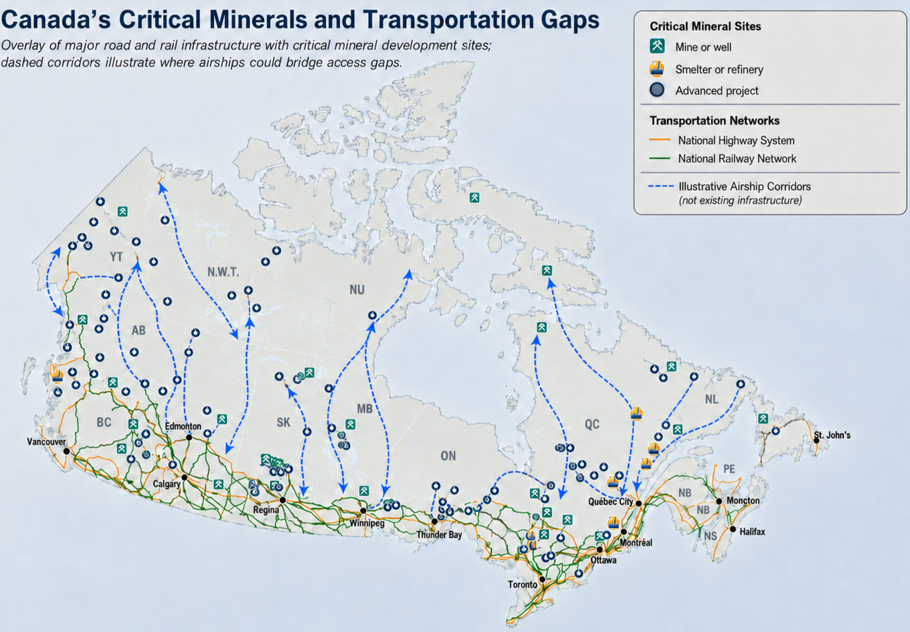
Yet many of Canada’s most strategically important mineral deposits remain effectively stranded by infrastructure constraints. In Figure 4 below one can see the mining resources or overlayed with the existing transportation infrastructure. Existing transportation infrastructure is shown in orange and green. Potential connections that use airship LIDVs are identified as blue dashed lines below. The gaps between resource sites and airship corridors could be filled by less inclement weather sensitive LIDV solutions such as hovercraft, cargo drones, and/or ground effect vehicles where practicable:
Figure 4 – Road/Rail Transportation Network & Critical Mineral Opportunities
In practical terms, access determines value. When comparing the existing road/rail network to the locations of the critical mineral sites, one can see that they are often not co-located. This has implications extending beyond transportation economics alone. In a previous paper, examining the relationship between logistics systems and remote land valuation, I argued that improved northern access can materially increase the underlying value of remote resource properties by reducing perceived project risk and lowering long-term infrastructure costs. In practical terms, reliable year-round logistics compress uncertainty. Projects previously considered marginal or prohibitively expensive become more financeable, more investable, and more strategically viable. Under modeled scenarios, these effects supported potential land value uplifts in the range of 20–40% for certain remote northern resource projects.
The link between land access and land value is strategically important because it reframes Arctic mobility infrastructure not merely as a transportation expense, but as a sovereign economic multiplier. Improved logistics access does not simply move cargo more efficiently; it changes how territory itself is economically perceived, financed, and developed.
Traditional land valuation models for remote northern properties have long reflected this reality through elevated capital expenditures, higher logistics costs, and increased discount rates associated with project uncertainty. In remote environments, distance from existing infrastructure acts not merely as a transportation variable, but as a multiplier of both infrastructure costs and operational risk.
Remote infrastructure constraints limit Canada’s ability to develop strategic resources, maintain permanent operational presence, strengthen northern communities, and attract private-sector investment. In this sense, inaccessible territory is not merely economically underdeveloped; it is strategically underutilized.
Transportation systems therefore become instruments of national power.
Improving northern access can materially alter both the economics and perceived risk profile of northern development projects. Reductions in transportation uncertainty compress financing risk, lower discount rates, and increase project viability. Access reliability becomes a form of risk reduction.
In northern Canada, risk reduction is value creation.
This distinction matters because it reframes Arctic infrastructure investment not as a regional subsidy, but as a strategic investment in national resilience, resource security, and sovereign capability.
Transportation costs remain one of the central structural challenges affecting northern Canada. Food insecurity, housing shortages, and the extreme expense of northern construction are all magnified by transportation limitations and dependence on expensive conventional airlift.
If Canada is serious about Arctic sovereignty, northern reconciliation, critical mineral development, and resilient northern communities, transportation systems must be understood as strategic national infrastructure rather than merely commercial services.
A distributed network of Arctic logistics hubs supported by persistent heavy-lift mobility platforms that do not require an associated hefty infrastructure bill (i.e. the construction expensive and climate change vulnerable road/rail networks) could dramatically increase operational flexibility across northern Canada. Such systems could support not only military sustainment, but also northern community resupply, emergency response, environmental monitoring, mining development, search and rescue operations, infrastructure support, and Indigenous economic participation.
Importantly, these are dual-use capabilities. A middle power like Canada benefits enormously from investments that simultaneously advance sovereignty, economic development, social resilience, and defence capability.
LIDVs should therefore be viewed less as standalone vehicle/platform and more as components within a broader Arctic access architecture. Their value lies not simply in carrying cargo, but in increasing the state’s ability to maintain persistent presence across remote territory.
The countries that will shape the future Arctic order are not necessarily those that possess the largest maps or the strongest legal claims. They will be the states capable of maintaining visibility, responsiveness, logistics continuity, operational awareness, sustained human presence, and resource access.
Canada cannot realistically match the military spending levels of the United States, nor can it replicate the authoritarian resource mobilization capacity of China (a self-proclaimed “near arctic state”) or Russia. What Canada can do, however, is pursue smart, asymmetric investments that maximize operational efficiency and strategic flexibility.
A values-based realist Arctic strategy would recognize that sovereignty cannot be separated from community viability, infrastructure resilience, environmental stewardship, Indigenous partnership, resource security, and long-term economic sustainability.
LIDVs are not a silver bullet. It is unlikely that they would fully replace roads, ports, icebreakers, or conventional aircraft. They may, however, allow Canada to stretch limited infrastructure and defence dollars while increasing strategic persistence across remote regions.
Ultimately, the Arctic sovereignty debate is not only about defence budgets or geopolitical rhetoric. It is about whether Canada can build systems capable of maintaining meaningful presence across one of the most geographically challenging territories on Earth.
Infrastructure matters because access matters.
And in the Arctic, access is sovereignty.
References:
Canada (2022) “Canada’s Critical Mineral Rich Regions” The Canadian Critical Minerals Strategy. Available at: https://www.canada.ca/en/campaign/critical-minerals-in-canada/canadian-critical-minerals-strategy.html#a3 (Accessed: 22 May 2026).
Carney, M. (2026) Policy Magazine. Available at: https://www.policymagazine.ca/the-old-order-is-not-coming-back-mark-carneys-speech-to-the-world-economic-forum/ (Accessed 22 May 2026).
D’Andrea A. (2023) “We now know the path the Chinese spy balloon took over Canada”, Global News. Posted 17 February 2023. Available at: https://globalnews.ca/news/9494290/chinese-spy-balloon-flight-path-canada/ (accessed: 22 May 2026).
Delaney, S. (2026) “Fractures Emerging in 86-Year U.S.-Canada Military Coordination as Trump’s Alliance Pressure Fuels Anti-American Drift”. The Economy. (Accessed: 22 May 2026). Available at: https://economy.ac/news/2026/05/202605289171
Dou, E. (2018) “A New Cold War? China Declares Itself a ‘Near-Arctic State’” The Wall Street Journal. 26 January 2018. Available at: https://www.wsj.com/articles/a-new-cold-war-china-declares-itself-a-near-arctic-state-1516965315. (Accessed 22 May 2026).
Normand, N. (2026) “Revaluing Remoteness: How Cargo Airships Could Justify a 20–40% Uplift in Northern Land Values” [unpublished paper. Draft submitted to the Association of Land Economists in May 2026 for consideration].
Transport Canada (2024) “Role of Canada’s Transportation Network” Available at: https://tc.canada.ca/en/corporate-services/transparency/corporate-management-reporting/transportation-canada-annual-reports/transportation-canada-2024/role-canada-s-transportation-network (Accessed: 22 May 2026).