Revaluing Remoteness:
How Cargo Airships Could Justify a 20–40% Uplift in Northern Land Values
Abstract
Access—and specifically the distance between remote resource properties and existing transportation infrastructure—has long been the defining constraint in the valuation of northern land, driving both operating costs and perceived project risk. Traditional appraisal approaches incorporate this constraint through elevated capital expenditures, high logistics costs, and risk-adjusted discount rates. Emerging logistics technologies—specifically heavy-lift cargo airships—introduce a potential shift in how access may be achieved, with implications for both cost structure and risk perception.
This article does not propose a new valuation framework. Instead, it demonstrates how adjustments to key inputs within established discounted cash flow and cost-based methodologies can produce a defensible uplift in land value. A representative remote mining project is modeled under baseline conditions and compared to a revised scenario incorporating improved, year-round logistics access.
Results indicate that while reductions in capital and operating costs contribute to value increases, the dominant driver is discount rate compression resulting from reduced supply chain uncertainty. Under reasonable assumptions, this effect supports a land value uplift in the range of 20–40%.
The analysis suggests that in remote northern contexts, access is not merely a cost factor but a primary determinant of risk. As logistics systems evolve, appraisal inputs must adjust accordingly, as improvements in access reliability can materially reprice land value through their impact on perceived project risk. The analysis further suggests that transportation distance is not merely a linear cost variable, but a multiplier of infrastructure risk, particularly where long all-season roads must be constructed and maintained.
Introduction
For land economists and valuation professionals, the primary constraint in assessing remote northern properties has consistently been access. Whether evaluated through discounted cash flow (DCF), cost adjustments, or risk-based discounting, geographic isolation—particularly in Canada’s North—imposes a structural discount on land value. The challenge of assessing remote northern properties has always been fundamentally tied to one variable: access. In practice, access constraints are closely tied to transportation distance. The farther a project lies from existing road, rail, or marine infrastructure, the greater the required investment in permanent logistics networks and the greater the exposure to seasonal disruption, maintenance costs, and infrastructure-related uncertainty. Prior research comparing cargo airships with all-weather road construction found that transport distance, road length, and traffic density are among the primary determinants of relative logistics competitiveness in northern resource development (Prentice et al., 2013). As distance from established infrastructure increases, the economics of fixed transportation corridors become increasingly difficult to justify, particularly for smaller or shorter-lived mining operations.
However, emerging logistics models, specifically heavy-lift airship systems, introduce a potentially material shift in how access may be achieved (Normand and Prentice, 2024). This article does not propose a new valuation framework. Instead, it demonstrates how modifying key inputs within established appraisal methodologies can, under defined conditions, support a defensible 20–40% uplift in land value for certain remote resource properties. Improved access would reduce logistics costs, expand the range of economically recoverable deposits, and increase the underlaying value of remote land accordingly. Note, these adjustments apply only where access airship solutions are commercially contracted, financeable, and integrated into project planning.
1. Standard Valuation Framework (No Methodological Change)
Consistent with standard valuation practice, land value is typically assessed using the income approach (often operationalized through discounted cash flow analysis) and the cost approach (through development or replacement adjustments). Across both approaches, valuation inputs are highly sensitive to risk assumptions, most notably through the selection of discount rates reflecting project uncertainty.
The key point is that no new valuation method is required—only revised assumptions reflecting improved logistics.
2. Baseline Case: Remote Northern Property (No Airship Access)
Consider a representative remote mining property characterized by no permanent road access, reliance on seasonal ice roads, and significant dependence on air freight. Comparable NI 43-101 feasibility studies for Canadian mining projects indicate capital expenditures ranging from several hundred million to over $1.5 billion, with mine lives typically spanning 15–20 years and base-case discount rates in the 8% range (e.g., Back River, Nunavut; Rose Lithium-Tantalum Project, Quebec).
Within this context, a representative case may assume approximately $1.0B in capital expenditure (CAPEX), $120M in annual logistics-related operating costs, a 15-year project life, and a 10% discount rate reflecting elevated uncertainty associated with remote northern operations. Assuming production revenues consistent with comparable mid-tier projects, these inputs produce an estimated net present value (NPV) of approximately $500M and a residual land value near $100M.
These assumptions are consistent with well-documented infrastructure constraints and transportation challenges in northern Canada, where limited networks increase both cost and uncertainty (Crown-Indigenous Relations and Northern Affairs Canada, 2019; Moyer, 2025; Transport Canada, 2020).
3. Distance as a Structural Cost Multiplier
In northern resource projects, distance imposes costs in two distinct ways. First, greater haul distances increase direct transportation costs through fuel, labour, maintenance, and freight requirements. Second, and often more significantly, increased distance from existing infrastructure frequently necessitates the construction of permanent transportation corridors such as all-season roads, bridges, staging facilities, and supporting maintenance infrastructure.
Prentice et al. (2013) demonstrated that the economics of remote transportation systems are highly sensitive to road length, mine lifespan, and freight density. Their analysis of northern mining scenarios found that the competitiveness of cargo airships improved materially as required road distances increased, particularly where road construction costs may range from approximately $3.6M to $5.0M per kilometre on average depending on terrain, water crossings, muskeg, permafrost conditions and environmental constraints (Prentice et al., 2013, p. 93, personal correspondence, May 2026).
This distinction is important from a valuation perspective because distance does not simply increase operating costs linearly. Beyond certain thresholds, remoteness requires large fixed infrastructure investments that materially alter project economics, financing requirements, and perceived risk. Figure 1 provides a conceptual illustration of how transportation distance may influence the relative economics of conventional road infrastructure versus flexible airship-based logistics systems in northern resource development contexts.
Distance from Infrastructure Conventional Road Economics Airship Relative Advantage
0–100 km Roads may be economical Moderate
100–300 km Only possible for very large deposits Increasing with Distance
300–600 km Infrastructure burden too severe Extremely Competitive
600+ km Impracticable No other economic choice
Figure 1 – Relative Competitiveness of Conventional Road Logistics & Cargo Airships by Distance
While project-specific economics remain highly dependent on terrain, freight density, mine lifespan, and commodity prices, the general relationship illustrates how increasing transportation distance progressively undermines the economic viability of fixed transportation infrastructure. At extreme distances, the cost and risk associate with permanent road construction may become prohibitive particularly for smaller or shorter-lived deposits.
4. Introducing Airship Access
Modern airship systems—currently under development by firms such as Flying Whales and Lockheed Martin (via AT2 Aerospace)—are increasingly being explored as a means of providing year-round access to remote regions without the need for permanent surface infrastructure. These systems are designed to transport heavy payloads directly to site, bypassing the constraints of seasonal ice roads and limited marine access. Unlike fixed transportation corridors, airship systems benefit from route flexibility and are not constrained by the need to construct continuous linear infrastructure between a mine and existing transportation networks. As a result, the economic penalty associated with remoteness may increase less sharply with distance than under conventional road-based logistics systems. This distinction becomes particularly important in projects requiring hundreds of kilometres of all-season road construction through muskeg, permafrost, or environmentally sensitive terrain.
A broader ecosystem is emerging around this technology. Dedicated logistics operators, such as Arctic Airships, are beginning to position airships as a commercial solution for remote supply chains, while supporting organizations such as ISO Polar are advancing Arctic-specific applications and infrastructure concepts. At the same time, smaller and emerging platforms—such as autonomous airship systems developed by Finland-based Kelluu—demonstrate the potential for persistent, all-season aerial access in extreme conditions.
Conceptually, airship-based logistics would operate through hub-and-spoke networks, linking remote sites directly to southern railheads, ports, or staging hubs (Normand and Prentice, 2024). Recent partnerships, including Canadian North’s collaboration with Flying Whales, highlight growing industry interest in deploying these systems in Arctic and northern environments (Exner-Pirot, 2023).
The competitiveness of airship-enabled logistics also depends significantly on the value-to-weight ratio of the resource being extracted. Extremely high-value, low-volume commodities such as gold or diamonds may already be economically viable using existing combinations of wither roads and conventional aircraft. The strongest market potential for cargo airships may therefore exist between these extreme: deposits where transportation infrastructure requirements are substantial enough to impair project economies, but where commodity values remain sufficiently high to justify premium logistics solutions.
5. Model Adjustments
The introduction of reliable, year-round logistics alters three key model inputs:
i. CAPEX reduction: The elimination or reduction of road and seasonal infrastructure requirements can materially reduce upfront capital investment. In remote northern contexts, where permanent transportation infrastructure is often required to sustain operations, replacing such assets with direct-to-site aerial logistics can avoid substantial capital outlays. While project-specific estimates vary, these effects may reasonably result in meaningful capital savings, particularly for projects otherwise reliant on all-season road construction or marine access infrastructure. The magnitude of these savings is strongly influenced by transportation distance. In conventional northern developments, greater remoteness often requires proportionally longer all-season roads whose construction costs may reach several million dollars per kilometre depending on terrain and environmental conditions (Prentice et al., 2013). Consequently, the economic advantage of flexible aerial logistics tends to increase as projects become more geographically isolated from existing infrastructure networks.
ii. Operating cost reduction: The shift from air freight to bulk transport represents a significant cost improvement. Air freight, while fast and reliable, is substantially more expensive per unit weight than surface or marine transport and is typically used only when alternatives are unavailable. In northern mining operations, disruption of winter road access can increase transportation costs by multiples, in some cases by 400% to 1000% (Krishnan, 2026) due to forced reliance on air logistics. The availability of year-round heavy-lift transport therefore offers a structural reduction in logistics-related operating costs by enabling bulk movement of fuel, equipment, and materials.
iii. Discount rate compression: While cost reductions are meaningful, the largest valuation impact arises from changes in perceived project risk. Discount rates in mining reflect a combination of technical, economic, and logistical risks. For development-stage projects, feasibility studies typically apply discount rates in the range of 5–10%, with observed values clustering near 7–9% based on empirical analysis of NI 43-101 technical reports and comparable project evaluations (Ovalle, 2020).
From a financing perspective, improved logistics reliability may reduce perceived execution risk among lenders and investors, thereby supporting lower required rates of return and improved access to project capital.
6. Recalculation
Applying the adjusted parameters derived from Section 4, a scenario can be constructed reflecting moderate improvements in capital efficiency, operating costs, and risk perception. This scenario assumes total capital expenditure of approximately $850M, annual logistics-related operating costs of $80M, and a reduced discount rate of 8%, consistent with lower project risk and improved financing conditions.
Under these revised assumptions, the project’s net present value (NPV) increases materially to approximately $700–750M. This increase reflects both lower initial investment and operating costs, and it is primarily attributable to the sensitivity of discounted cash flow valuations to even modest reductions in the discount rate.
7. Land Value Implications
The increase in project NPV translates directly into higher residual land value, rising from approximately $100M in the baseline case to an estimated $140M–180M under the revised logistics scenario. This reflects the combined effects of lower capital requirements, reduced operating costs, and improved financing conditions.
However, appraisal practice typically applies a degree of conservatism when incorporating emerging technologies or unproven logistical assumptions. As a result, not all modeled gains are fully capitalized into land value. After accounting for this conservatism—reflecting uncertainty in deployment timelines, technology maturity, and adoption—the analysis supports a justified land value uplift in the range of 20–40%.
This range captures both the material economic impact of improved logistics and the need to discount early-stage assumptions, resulting in a balanced and supportable adjustment to land value. Importantly, the majority of this uplift is attributable to reduced perceived risk rather than direct cost savings, reinforcing the central role of logistics reliability in remote land valuation.
8. Sensitivity Analysis
Sensitivity testing of key model inputs demonstrates that the estimated land value uplift is robust across a range of assumptions. Variations in capital expenditure, operating costs, and discount rates produce land value increases ranging from approximately 20% under conservative assumptions to 40% under more optimistic scenarios.
While reductions in CAPEX and operating costs contribute to value improvement, the model is most sensitive to changes in the discount rate. The sensitivity of valuation outcomes to distance is also significant, as greater separation from existing transportation infrastructure increases both the capital intensity and risk exposure of conventional logistics models. Even modest reductions in the discount rate—reflecting improved supply chain reliability and reduced project risk—generate disproportionately large increases in net present value and, by extension, residual land value.
This reinforces the conclusion that the primary economic benefit of improved logistics is not solely cost reduction, but the re-rating of project risk. As a result, the estimated uplift range can be considered both stable and defensible across plausible variations in underlying assumptions. In contrast, variations in CAPEX and operating costs produce more linear and proportionally smaller changes in valuation outcomes.
9. Key Driver: Discount Rate Compression
The primary driver of value uplift is not cost reduction alone, but discount rate compression. In discounted cash flow (DCF) valuation, the discount rate reflects the risk-adjusted return required by investors, and small changes in this rate can have a disproportionate impact on present value (Damodaran, 2012).
Reducing the discount rate from 10% to 8% materially increases project NPV, reflecting improved certainty of project execution, greater supply chain reliability, and enhanced financing conditions. In remote northern contexts, logistics reliability directly influences perceptions of execution risk. Airship-enabled access, if demonstrated to be commercially viable, effectively shifts the project along the risk spectrum rather than simply lowering costs.
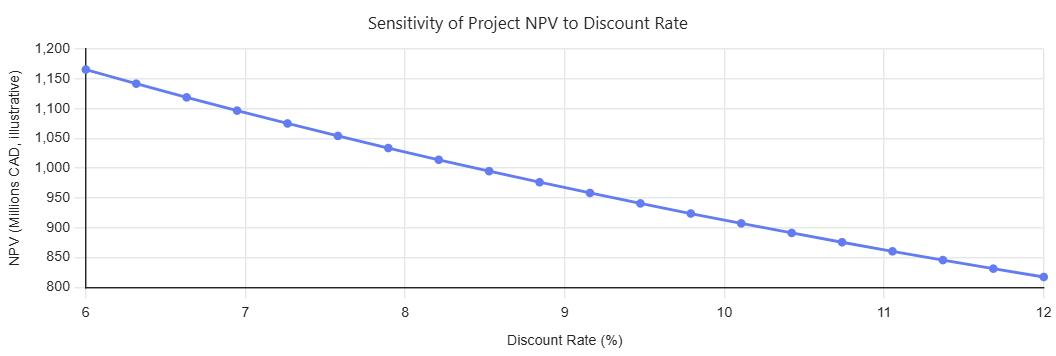
Figure 2 illustrates the sensitivity of net present value to changes in the discount rate under a simplified cash flow profile. The curve shows a non-linear relationship: as the discount rate declines, the incremental increase in NPV accelerates. This reflects the compounding effect of discounting over long project lives.
As shown in Figure 2, a reduction in the discount rate from 10% to 8% produces a substantial increase in NPV, despite relatively modest changes in underlying cost assumptions. In remote northern projects—where baseline discount rates are elevated due to uncertainty—improvements in logistics reliability can therefore have an outsized impact on valuation relative to cost reductions alone.
Figure 2 Sensitivity of Project NPV to Discount Rate
Figure 2 shows that reducing the discount rate from 10% to 8% increases NPV by approximately $100–120M under the modeled cash flow profile, illustrating the magnitude of risk-driven valuation effects.
10. Defensibility
These assumptions are grounded in a convergence of empirical and policy evidence. Infrastructure gaps and logistical constraints in northern Canada are well documented, with many communities and industrial sites lacking permanent transportation access and relying on seasonal or multimodal supply chains. Government policy frameworks recognize longstanding deficiencies in northern transportation infrastructure and emphasize the need for improved connectivity to support economic development (Crown-Indigenous Relations and Northern Affairs Canada, 2019).
At the same time, climate change is reducing the reliability of existing logistics systems. In particular, winter roads—historically a critical supply mechanism for remote mining operations—are becoming less dependable due to later ice formation and earlier thaw cycles, shortening operational windows and increasing uncertainty (Blake, 2022). These changes materially elevate supply chain risk and associated cost volatility.
Parallel to these structural pressures, airship-based logistics are progressing beyond conceptual stages. Industry partnerships, including Canadian North’s agreement with Flying Whales to evaluate cargo airships for Arctic deployment, demonstrate emerging commercial interest in alternative logistics solutions capable of reducing infrastructure dependence and transportation costs (Tranter, 2023).
Taken together, these trends support the plausibility of airship-enabled logistics as a credible future access solution. Importantly, valuation adjustments do not require full deployment of such systems, but rather evidence of technical feasibility, commercial traction, and integration into project planning assumptions. Where access solutions are demonstrably financeable and contractually supported, they can reasonably influence perceived project risk and therefore valuation.
Accordingly, airship-based logistics need only reach a level of credibility sufficient to influence financing and risk assessment—not full operational maturity—to affect land value. This reflects standard appraisal practice, where anticipated but not yet fully realized changes in access or infrastructure can be partially incorporated into value through risk-adjusted assumptions.
Conclusion
The transition from intermittently accessible to reliably serviced fundamentally alters the valuation profile of remote land. As logistics systems evolve, appraisal inputs must adjust accordingly. In northern land economics, access is not merely a cost factor—it is a primary determinant of risk. The introduction of reliable logistics does not simply lower costs; it reclassifies projects along the risk spectrum, compresses discount rates, and unlocks latent land value. In remote regions, access is not just infrastructure—it is risk reduction. Moreover, the valuation impact of improved access is magnified by distance itself: the farther a resource property lies from existing infrastructure networks, the greater the potential economic advantage of flexible logistics systems capable of reducing fixed infrastructure dependence. Risk reduction, in discounted terms, is value creation. Therefore, access equals value; to increase the accessibility is to increase the value of the land.
References:
Blake, Emily. (2022) Limited transportation infrastructure facing threats in the North. CBC News. Available at: https://www.cbc.ca/news/canada/north/northern-infrastructure-climate-1.6654833
Crown Indigenous Relations and Northern Affairs Canada. (2019) Arctic and Northern Policy Framework. Available at: https://www.rcaanc-cirnac.gc.ca/eng/1560523306861/1560523330587
Damodaran, Aswath. (2012) Investment Valuation: Tools and Techniques for Determining the Value of Any Asset. Wiley.
Exner-Pirot, Heather. (2023) Airship ready, Canada should develop zeppelin technology for northern resource sector: A revival of airship technology could hugely benefit Canada's northern communities, natural resource development and Arctic security. Globe and Mail. Available at: https://www.theglobeandmail.com/business/commentary/article-canada-zeppelin-technology-northern-sector/
Krishnan, Salini (2026) Northern mining infrastructure: What it is, why it matters, 2026 outlook. Skillings Mining Review. Available at: https://skillings.net/northern-mining-infrastructure-matters/
Moyer, Jason, C. (2025) Prioritizing Canada’s investment in Arctic infrastructure. Atlantic Council. Available at: https://www.atlanticcouncil.org/in-depth-research-reports/issue-brief/prioritizing-canadas-investment-in-arctic-infrastructure/
Normand, Norm and Prentice, Barry. (2024) Airships for the Arctic. Canadian Defence Review. Available at: http://viewer.zmags.com/publication/4baea969#/4baea969/62
Ovalle, A. (2020), 'Analysis of the discount rate for mining projects', in R Castro, F Báez & K Suzuki (eds), MassMin 2020: Proceedings of the Eighth International Conference & Exhibition on Mass Mining, University of Chile, Santiago, pp. 1048-1064, available at: https://papers.acg.uwa.edu.au/p/2063_76_Ovalle/
Prentice, Barry E. (2026) Personal Correspondence with author regarding cargo airship competitiveness, transportation distance, and northern infrastructure costs. May 2026.
Prentice, Barry E., Nirbir Grewal, Bryce Doell, and Matt Adaman. (2013) Cargo Airships Versus All-Weather Roads – A Cost Comparison. Proceedings of the 48th Annual Meeting of the Canadian Transportation Research Forum, pp. 89–104.
Quesnel, Joseph. (2025) AT2 Aerospace secures major airship order from Arctic Airships. Canadian Mining Journal. Available at: https://www.canadianminingjournal.com/news/at2-aerospace-secures-major-airship-order-from-arctic-airships/
Transport Canada. (2020) Northern Canada: Transportation in Canada 2020. Available at: https://tc.canada.ca/en/corporate-services/transparency/corporate-management-reporting/transportation-canada-annual-reports/2020-2021/northern-canada
Tranter, Emma. (2023) Canadian North signs deal to design airship. CBC News. Available at: https://www.cbc.ca/news/canada/north/canadian-north-signs-deal-to-launch-airships-in-the-north-1.6899363