Too Much Geography, Not Enough Access
A geography-first look at distance, northern development, and the return of airships as a serious logistics idea.
By Commander Norm Normand, MBA, PCSC, CD
Canada is often described as a country defined by distance. In a well-known speech to the House of Commons in 1936, Prime Minister William Lyon Mackenzie King observed that “if some countries have too much history, we have too much geography.” Distance alone does not explain the challenge of developing the North. The deeper problem is access.
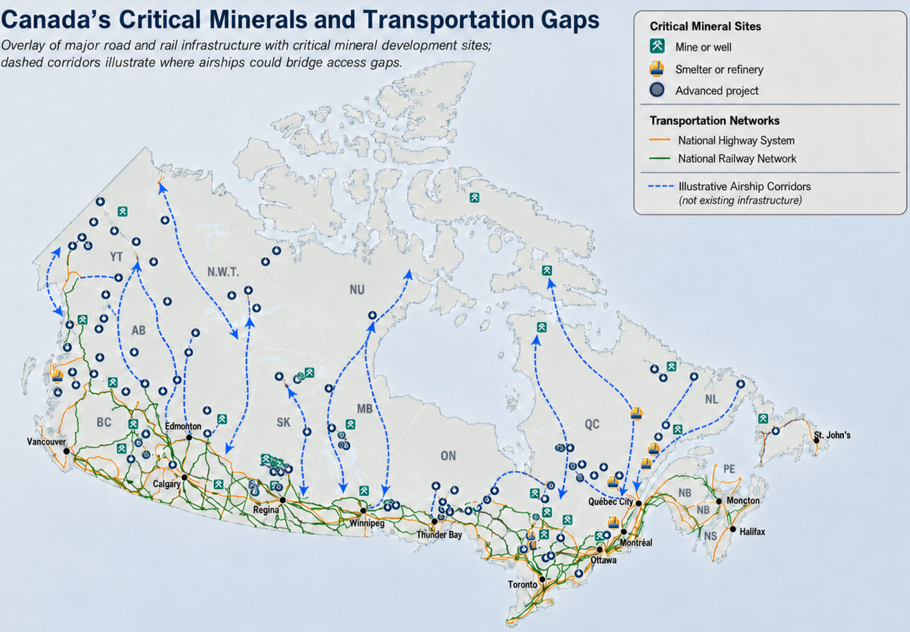
On a map, Canada appears richly connected. A web of railways and highways (in green and orange in Figure 1 below) stretches from Vancouver to Halifax, linking ports, cities, farms, factories, mines and markets. But look closer and the pattern changes. Much of that network hugs the southern edge of the country. It follows the population. It follows the border. It follows the geography of a country where most people live within a narrow band near the United States.
Now place Canada’s critical mineral potential on that same map. Lithium, nickel, cobalt, copper, rare earth elements, graphite, and other minerals important to clean energy, digital technology and defence supply chains are scattered across the country. Some are close to roads, railways, ports and processing facilities but many are not. Some sit beyond the practical reach of all-season transportation. Others are located in regions where seasonal roads, ice roads, short shipping windows or expensive air freight determine whether a project is viable.
This is the gap the map reveals. Canada has resources. Canada has transportation infrastructure. But they do not always meet.
Every event we host is designed with intention, from the atmosphere we create to the way each session flows.
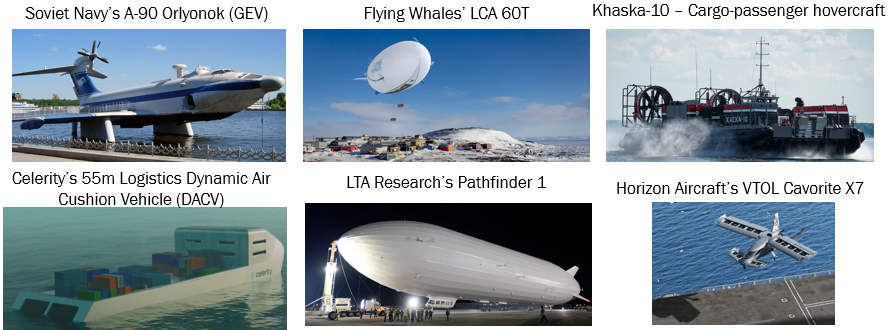
Figure 1. Canada’s critical minerals and transportation gaps. The dashed blue lines illustrate potential airship corridors that could connect remote mineral regions to existing road, rail and port infrastructure. Sources: Transport Canada; Natural Resources Canada.
A Country of Corridors
Critical minerals are not just another commodity category. They are used in batteries, wind turbines, electric vehicles, satellites, semiconductors, telecommunications systems, advanced manufacturing and defence applications. The Government of Canada has identified 34 minerals and metals as critical because they are tied to economic security, national security, supply chain resilience and the transition to a lower-carbon economy.
In other words, critical minerals are no longer only a mining story. They are also a geography story.
Canada’s transportation system is one of the foundations of the national economy. Roads, railways, ports and airports move people, goods and materials across enormous distances. The system is especially strong along established corridors: the Pacific gateway through Vancouver and Prince Rupert; the Prairie corridors moving grain, potash and energy; the central networks around Ontario and Quebec; and the Atlantic connections through Halifax, Saint John and St. John’s.
But the farther one moves north from those corridors, the thinner the network becomes. That thinning is not accidental. Figure 1 suggests three broad north-south access corridors where new transportation approaches could help bridge gaps between Canada’s existing infrastructure and remote mineral regions: western, central and eastern corridors. Roads and railways are expensive to build anywhere. In northern Canada, they become dramatically more difficult. Muskeg, permafrost, mountains, extreme cold, river crossings, short construction seasons and long distances increase costs and risk. Climate change adds further uncertainty by threatening winter roads and destabilizing ground conditions that older infrastructure may have relied upon.
For remote mining projects, access can become the decisive factor. A mineral deposit may be geologically promising but economically stranded. The ore may be valuable, but if fuel, equipment, workers, construction materials and supplies cannot reach the site affordably and reliably, the project may remain undeveloped. In that sense, remoteness is not simply a location. It is a cost structure.
The Hidden Price of Access
When Canadians think about northern transportation, they may often envision dramatic one-time images: aircraft landing on gravel strips, sealift vessels arriving during a short summer window, winter roads crossing frozen lakes, or convoys hauling heavy equipment across ice.
Those images are real. But the deeper issue is continuous reliability. A mine, community or defence installation does not need access once. It needs access repeatedly. Food, fuel, building materials, replacement parts, medical supplies, tools, vehicles, communications equipment and construction materials all must move in. Waste, samples, equipment, people and eventually products must move out.
The same access problem affects communities as well as mines. A shipment that looks like a line on a map becomes groceries on a shelf, lumber for a house, diesel for a generator, medicine for a clinic or parts for a water system. In remote places, transportation is not an invisible background service. It is one of the conditions that determines what things cost, how quickly they arrive and whether people can remain in place with dignity.
Where all-season roads or railways do not exist, that movement becomes expensive. Air freight is fast but costly. Sealift is efficient but seasonal. Winter roads are useful but increasingly vulnerable to changing climate conditions. Building permanent roads can unlock access, but long roads to individual resource sites can impose enormous upfront capital costs and environmental disturbance.
That is why distance from infrastructure can determine the economic fate of a remote project. A mineral deposit 50 kilometres from a road is a very different proposition from one 500 kilometres away. This is where the Low Infrastructure Demand Vehicle (LIDV) concept becomes compelling.
Airships as Infrastructure Without a Road
LIDVs such as cargo airships are often associated with the past: Zeppelins, dirigibles and early aviation. But the idea is being reconsidered for a very modern problem: how to move large cargo into places that lack infrastructure. For the purposes of this article, airships are one example of a broader family of low infrastructure demand vehicles, or LIDVs: transportation systems designed to reach places without requiring long roads, railbeds or large paved runways.
Unlike trucks, LIDVs such as cargo airships do not need roads. Unlike trains, they do not need railbeds. Unlike large aircraft, they may not require long paved runways. In theory, an airship could move heavy or bulky freight between existing southern transportation hubs and remote northern locations while leaving a much lighter footprint on the land.
For Canada, that possibility is more than a novelty. It suggests a different way to think about northern access. Instead of building a permanent road or railway to every remote site, airships could connect remote projects and communities to existing transportation corridors. Southern ports, railheads, highways and airports could act as staging points. From there, cargo airships could move goods north and south, filling the gaps between infrastructure and resources.
On a map, this looks simple: dotted blue lines running north and south between mineral regions and the existing road and rail network. In reality, such a system would require testing, regulation, investment, weather analysis, Indigenous partnership, business planning and operational discipline. But conceptually, it changes the question. The question is no longer only, “How do we extend roads into the North?” It becomes, “How do we extend access?”
Critical Minerals and National Resilience
The importance of that distinction is growing. Canada is not the only country looking at critical minerals. Around the world, governments are trying to secure reliable supply chains for the minerals that support clean technology, digital infrastructure and defence production. Supply disruptions, geopolitical rivalry and concentration of processing capacity have made mineral security a strategic concern.
For Canada, this creates both an opportunity and a responsibility. The opportunity is economic. Canada has significant mineral potential, a stable political system, established mining expertise and access to global markets. If critical mineral projects can be developed responsibly, they could support jobs, Indigenous partnerships, regional growth, and value-added processing.
The responsibility is geographic and environmental. Much of this potential lies in regions where development must be carefully planned. Northern ecosystems are sensitive. Communities must be partners, not afterthoughts. Transportation choices can shape landscapes for generations.
This is another reason airships deserve attention. Roads can bring lasting benefits, but they also create permanent corridors of disturbance. They can alter wildlife movement, hydrology and settlement patterns. Airships would not eliminate environmental impact, but they could reduce the need for some linear infrastructure in certain contexts. That matters in a country trying to balance climate goals, reconciliation, resource development and sovereignty.
Access Changes Value
There is also a subsequent economic effect. Improved access does not merely reduce the cost of moving freight. It can change how land itself is valued.
Remote properties are often discounted because of risk. If a project depends on seasonal roads, expensive air freight or uncertain supply chains, investors price that uncertainty into their calculations. The deposit may be rich, but the risk of getting to it — and sustaining operations once there — lowers its value.
Reliable logistics can change that. If year-round access becomes more credible, projects may become more financeable. Transportation costs may fall. Construction schedules may become less uncertain. Supply chains may become more dependable. In a separate land-economics analysis, I modelled how improved year-round logistics could affect the value of remote northern resource properties. Under reasonable assumptions, better access supported a potential land-value uplift in the range of 20 to 40 per cent for some remote projects.
The point is not that every northern property would suddenly become more valuable. It is that access changes risk, and risk changes value. This is where geography becomes economics. A place does not move, but its relationship to the national transportation system can change. If access improves, remoteness becomes less punishing. A stranded asset can become a strategic opportunity.
Sovereignty Through Connectivity
There is a sovereignty dimension as well.
Canada’s Arctic and northern regions are not empty spaces. They are homelands, ecosystems, communities, resource regions and strategic frontiers. Exercising sovereignty over them requires more than lines on a map. It requires presence, mobility, observation, emergency response and the ability to support people who live there.
Transportation is one of the ways a country makes itself real across space. A network of airship corridors would not replace patrol vessels, satellites, aircraft, ports, runways, roads or railways. But it could add a new layer to Canada’s northern presence. Airships moving regularly between southern infrastructure and northern communities or projects could support resupply, search and rescue, emergency response, environmental monitoring and economic development.
For a country with Canada’s scale and population, systems that serve more than one purpose matter. A transportation network that can move freight, support communities, enable emergency response and improve access to resources is not just an economic tool; it is a way of making the country more connected to itself.
Airships could move freight. They could support communities. They could connect resource projects. They could create economic options. They could improve response capacity and situational awareness. They could make remote regions more visible and more reachable. In a country shaped by distance, reach matters.
That is why alternative mobility systems remain worth serious consideration. The issue is not whether airships are old or new. It is whether an older transportation idea, updated with modern materials, sensors, navigation, automation and operating models, can help solve a distinctly Canadian access problem.
Low infrastructure demand vehicles such as cargo airships, hovercraft and ground-effect vehicles are often dismissed as futuristic curiosities or relics of a bygone era. Yet advances in materials science, automation, avionics and weather forecasting have renewed interest in transportation systems that can reach places conventional infrastructure struggles to serve. Figure 2 illustrates several examples of low-infrastructure transportation concepts. Some are already in use; others remain under development.
Figure 2. Examples of low-infrastructure transportation concepts, including cargo airships, hovercraft and ground-effect vehicles.
A Canadian Experiment Worth Trying
None of this means airships or other low-infrastructure transportation systems are guaranteed to succeed. They face real challenges: weather, certification, capital costs, ground handling, public perception, insurance, operating models and the hard reality of proving performance in northern conditions.
But Canada has often been built by transportation experiments. Canoe routes, railways, bush planes, ice roads, seaways, pipelines, ferries and northern airports all changed how the country understood distance. Some were transformative. Some were imperfect. All reflected the same basic truth: geography shapes possibility.
Today, the map is asking a new question. Can Canada connect its critical mineral potential to its transportation network without simply repeating the infrastructure models of the past?
Airships may not be the whole answer. But they may be part of a more flexible, lower-footprint, geography-aware approach to northern access. The gaps on the map are not just empty spaces. They are choices waiting to be made.
References:
Statistics Canada. (2009) Geography. Available at: https://www150.statcan.gc.ca/n1/pub/11-402-x/2008/4017_3119/ceb4017_3119_000-eng.htm
Canada, Natural Resources. (2024) Government of Canada releases updated Critical Minerals List. Available at: https://www.canada.ca/en/natural-resources-canada/news/2024/06/government-of-canada-releases-updated-critical-minerals-list.html
Normand, N. (forthcoming) Revaluing Remoteness: How Cargo Airships Could Justify a 20–40% Uplift in Northern Land Values. The Land Economist.
Transport Canada. (2024) Role of Canada’s Transportation Network. Available at: https://tc.canada.ca/en/corporate-services/transparency/corporate-management-reporting/transportation-canada-annual-reports/transportation-canada-2024/role-canada-s-transportation-network
Tranter, E. (2023) Canadian North signs deal to design airship. CBC News. Available at: https://www.cbc.ca/news/canada/north/canadian-north-signs-deal-to-launch-airships-in-the-north-1.6899363